Lighting Resources
The resources on this page are free and provided as-is without warranties or guarantees.
The resources on this page are free and provided as-is without warranties or guarantees.
The ETC Ion Xe lighting control console sits rather flat on the table and is prone to tipping forward when too much pressure is applied to the rest. Print and install these legs to prevent tipping and place the console at the same angle as the classic Ion console.
Since the above video was posted, additional versions of the legs were created!
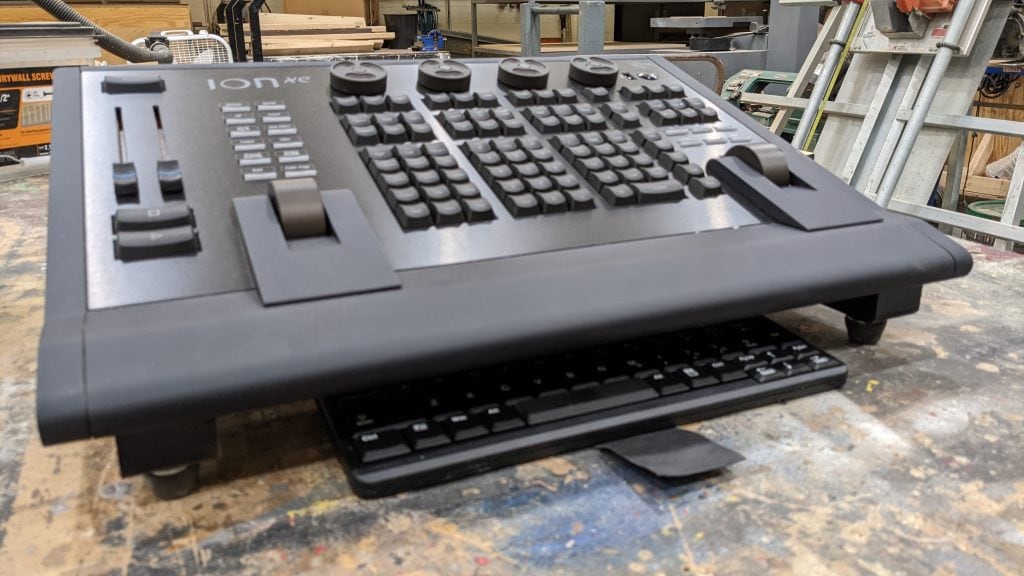
As shown below, there are now legs which will create keyboard clearance under the console. A piece of folded gaff tape is shown added to the keyboard to more easily grab it and pull it out from under the console.
As shown below, there are also parts to help you build a cradle so your console can still sit at an angle if you don’t want to permanently attach 3D-printed legs to the bottom.
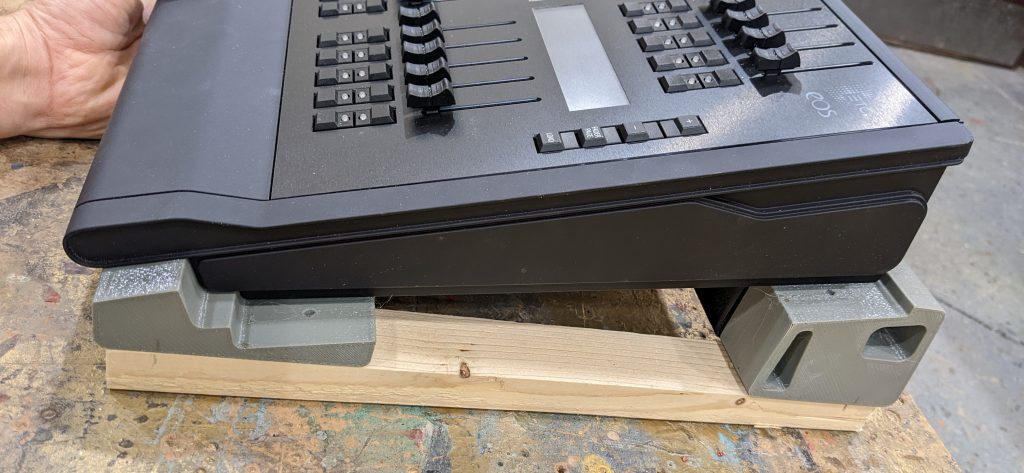

Zip folder containing instructional PDF, DWG file, VWX file, and STL part files.
Intended for beginners, this five-part video series provides a comprehensive look at the process of lighting a theatrical production.
The process is explained through the example of the 2008 Norwich High School Musical Club production of My Fair Lady.
Part 1 focuses on what lighting design is, how design decisions are made, and how the design is documented. Part 2 focuses on script analysis and scenery considerations. Part 3 focuses on getting from the script to the documentation needed to implement the design. Part 4 focuses on how the design is implemented. Part 5 reviews the results of the entire process.
Author’s note: This series was created when I was very early in my career and lighting technology was quite different than it is today. For the show featured, I was using an ETC Express 48/96 console and no LED or moving lights. Beyond the technology, if I were recreating this series today I am sure I would have many different things to say. It is possible I said things then that lacked context or nuance, or that I would not even agree with today. I don’t claim that what I presented is the “correct” or only way to effectively go about designing lights for a show. I have debated unpublishing this video series, but I think it could still be valuable to true beginners. No matter how much the technology has changed, the fundamentals are still the same. Lastly, my lighting education included the books Stage Lighting Design by Richard Pilbrow and Designing with Light by J. Michael Gillette. The knowledge they shared in those texts informed some of what is presented in the videos.
If you would like to send thanks or support for further resource development, you can Buy Me a Coffee.